Having put in the effort to learn where and how to get stuff in my first few weeks in Basel, I was soon filled with an increasingly intense desire to learn where and how to throw stuff away, in the sense that my house was soon increasingly intensely filled with junk that I needed to throw away.
Switzerland’s refuse disposal system is one of many much-publicized sources of national pride. The Swiss often seem to take a lot of pride in being Swiss. There’s no denying that they get a lot right, and one of their national successes has been to cultivate a pretty enthusiastic recycling culture, about which local outlets are more than happy to crow.
You can’t look anywhere online without seeing a blog, newspaper, or magazine reference to Switzerland’s “high recycling rates.” The proudest among Swiss sanitation enthusiasts even like to claim that the Confoederatio Helvetica is among the world’s greatest recyclers; that might be true, depending on how you slice the garbage cake, but the Germans, Austrians, South Koreans, Slovenians, Belgians, and Taiwanese, at least, seem to have the Swiss beat.
But like the plastic bags I inevitably wind up choosing when I scoop the litterbox, the Swiss garbage disposal system has some holes in it.
Swiss sanitation offers a large-scale example of the design peaks and valleys you start to notice all over the place after spending just a little time here (and this will be the subject of an imminent post)—points of great efficiency, thoughtfulness, and beauty interspersed with what seem like arbitrary complications.
Talking Trash
The garbage part of the garbage disposal system (Abfall, or waste), the non-recyclable trash that gets incinerated, largely for energy recovery nowadays, or decreasingly often, landfilled, is mostly a thing of great, common-sense beauty.
Like some other municipal sanitation programs around the world (the small college city of Ithaca, New York does something similar), it’s based on the “polluter pays principle.” In Basel, the city sanitation department that does all the trash collection has a monopoly on the production of Bebbi-Säcke, or “Basler Sacks,” using one of the cutesy diminutive Swiss German variations on the word for someone or something from Basel (the Zürich versions, incidentally, are known as Züri-Säcke, along the same lines).
They’re easy to find, behind the counter at grocery stores, and cost 24 francs for ten 35L units. So yes, you read that right: Medium-sized trash bags (like a small kitchen sack) cost close to $2.50 apiece (you are also welcome to get smaller ones for a little less, and larger ones for more).
Bebbi-Säcke are uncommonly high-quality trash bags. Brilliant blue in color; impressively durable (I feel confident that I could toss broken glass into them without having the bottom fall out on me, although I’m also pretty confident I’d get arrested for trying to toss broken glass into a Bebbi-Sagg); apparently leakproof (I’ve taken out more than one Bebbi-Sagg loaded with wet coffee grounds, and at least one wet rag used for washing a litterbox, even going so far as to hoist it up on my shoulder while carrying it down the stairs, and I have without exception emerged unscathed and unscented); equipped with fine strong drawstrings (good enough to semi-reliably seal them shut, when tied aggressively as labels on the bags encourage, and if they’re not too heavy, strong enough once tied to use as a handle to carry them down from your fourth-floor walkup, or whatever type of Swiss apartment you live in).
Bebbi-Säcke are a world apart from the cheapo drug store trash bags I have experienced in my more foolish moments in the States. I have increasingly sporadic periods of near-pathological frugality, where buying the cheapest available version of a thing seems the irresistible option, and I have learned the hard way that trash bags are one of at least two items for which it never pays to follow that instinct (unless you like cleaning up spilled cat waste, soup, soggy paper towels, or whatever horrifying species of garbage juice your household produces, after you take out the trash).
The other item that taught me this principle, incidentally, is disposable razors. It’s amazing that something that seems to have such a hard time accomplishing its one job can hurt so much while it fails to do it. If you are in a dollar store while reading this, thinking about buying a pack of disposable shavers imported from China via Northern Macedonia, please love yourself enough to think again. The second-cheapest might actually work, though.
Anyway, what really differentiates Bebbi-Säcke from cheaper options is the fact that there are no cheaper options. It’s officially illegal to dispose of any non-recyclable anything in any bag apart from a Bebbi-Sagg.
But the Bebbi-Sagg’s noticeable price tag also covers your twice-weekly refuse collection. Just follow local guidelines about when you’re allowed to leave your full bags on the curb (in our current zone, it’s Monday and Thursday mornings), and a cute little orange truck with a cheerful cartoon pig on it will swing by and your trash will disappear.
So trash disposal is extremely low-effort for the waste producer, but costs a lot.
Recycling, on the other hand, is free. It further adheres to the polluter pays principle by making it really expensive to get caught throwing away recyclables—the fines start around CHF/US$100. Penalties for dumping household waste into public recycling bins are even more frightening, starting around CHF200.
Like public transit fares and public parking time limits, recycling violations are kept under control largely through the national honor system (and much more on this soon), so I expect these fines are seldom levied, but scrupulously paid and collected when they are.
But as if to make up for being free, Swiss recycling is a sort of DIY affair, requiring thought and effort on the consumer’s part. Paper and cardboard make up the easiest (but maybe also least convenient) part, getting collected off the street once a month, assuming proper bundling and presentation. I say least convenient because I have now missed our monthly paper pickup day twice, and have a cabinet filled with hoarder-worthy bales of cereal boxes to prove it. But that’s my fault, not the system’s.
Rejected recycling and trash are left behind on the street, with a scolding sticker attached. Even if they didn’t see you carrying it out, and don’t see you slinking it back in, you can be sure your Swiss neighbors will know the offending trash was yours. So real enforcement of waste management regulations may take place in the court of neighborhood opinion, sure to be a higher price to pay even than the steepest citation.
Everything apart from paper has to be taken to an appropriate recycling center. Everyone seems to agree that these are well located and easy to reach from more or less anywhere within Basel city limits; the one closest to us is about three minutes’ walk from my front door. But, as a valley to this particular systemic peak, there’s no single recycling center that takes everything, and even a recycling center appropriate to the type of material you’re trying to pitch probably doesn’t take everything you think it does.
By you, of course, I mean me.
The municipal recycling center closest to our place handles glass carefully sorted by color (there are separate bins for Weiss-, Grün-, and Braunglas), Aluminium und Weissblechdosen. We had to ask our relocation consultant what Weissblech was; either she didn’t know either, or just didn’t know the English, and vaguely offered that it was something like aluminum, but thinner, maybe? Or slightly thicker? (Literally, it appears to be ‘tinplate,’ but that’s probably just a vestige of an earlier era, like our ‘tin cans’ or ‘tins.’.)
Anyhow, I figured that that was where we should put metal, and I dumped whatever scraps of metal and foil I gathered around the house for a couple of weeks before I noticed that the bins were labeled for not just any kind of Aluminium and Weissblech, but Aluminium- und Weissblech–[D]osen, a word that in other contexts (specifically, beverage labels) I mistook for ‘dose’ or ‘portion’ but which is actually a can. Cans and tins only. Other metallic stuff is, at least according to official signage, not the city’s problem.
Adjacent to the small receptacles for each category of trash is a large, blue dumpster-like container that is labeled to outline the acceptable forms of recycling to put in the cans you just had to walk by to reach it, reiterates the fines and penalties for inappropriate disposal, and has a small slot into which you are supposed to insert… I have no idea what. Stuff that didn’t fit into the segregated bins? Other categories of recyclable material? Garbage (but not bags of household garbage, or the cheerful cartoon pig is fining you two hundred francs)?
People are clearly hoping for some of each of the above, based on the things I see in, on, or next to that bin.
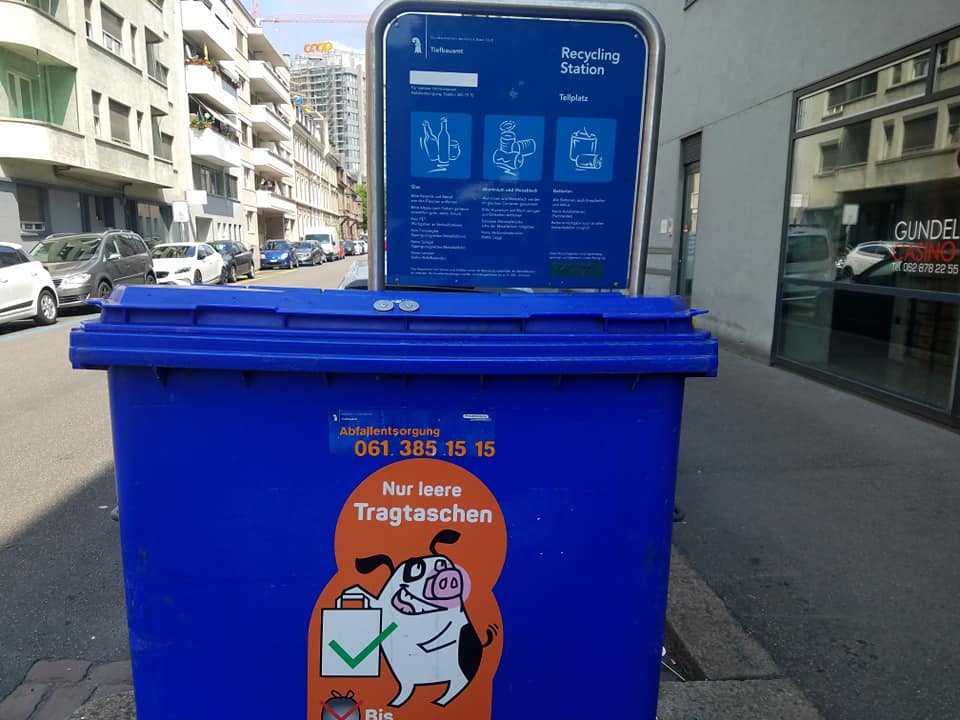
…so I’m not the only one who finds this confusing.
As orderly, neat, and rule-bound as Switzerland supposedly (and mostly) is, there’s actually a lot of fudging, guessing, and cheating surrounding the waste disposal system. Not only are my neighborhood curbs invariably full of Bebbi-Säcke well in advance of official disposal hours (you’re supposed to wait until 7PM to put them out), people clearly aren’t sure what to stick where at the recycling stations, hopefully abandoning pots and pans, broken glassware, dishes, umbrellas, and more next to whichever bin they think is the closest fit (nice try putting the umbrella between the Aluminium- und Weissblechdosen and Weissglas cans, anonymous neighbor).
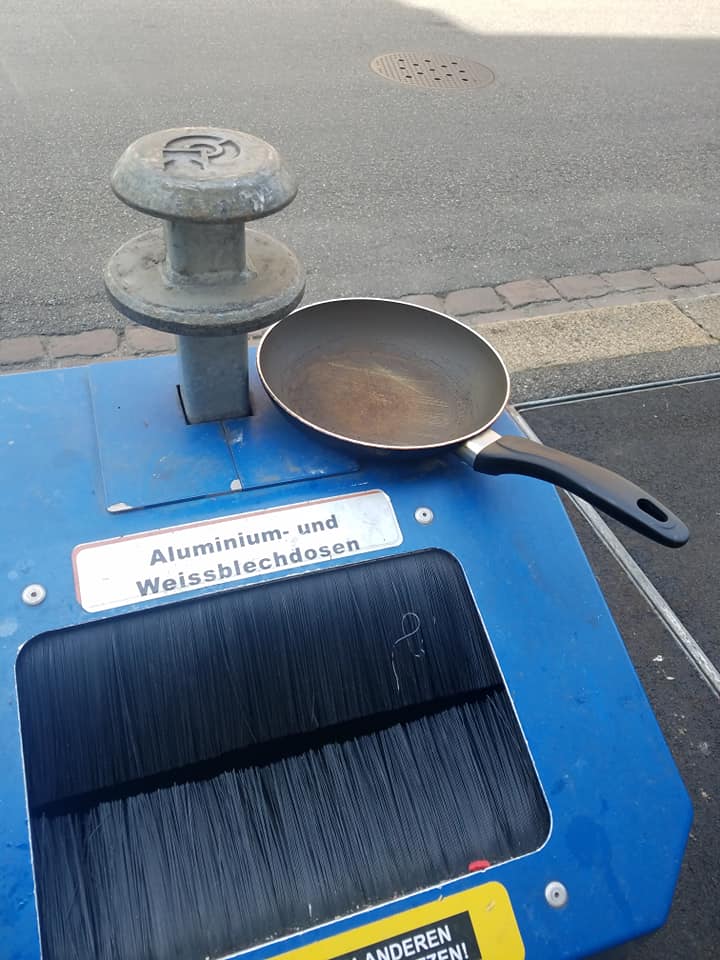
Plastic receptacles, on the other hand, are nowhere to be seen at our local recycling depot. To get rid of PET bottles (and also batteries, light bulbs, carbonation and cream-charging cannisters, I think) you need to head to the lobby of your local supermarket… obviously?
Both Coop and Migros have a wall of curiously shaped windows out front, labeled with the kind of recyclables for which they are intended. Our Coop divides acceptable plastic into two categories: PET-Getränkeflaschen, or PET Drink Bottles, and PET-Plastikflaschen, or PET Plastic Bottles. Assuming the diagrams on the walls are to be believed, these slots are for detergent bottles, opaque milk bottles, and other non-beverage plastic containers, opaque in color.
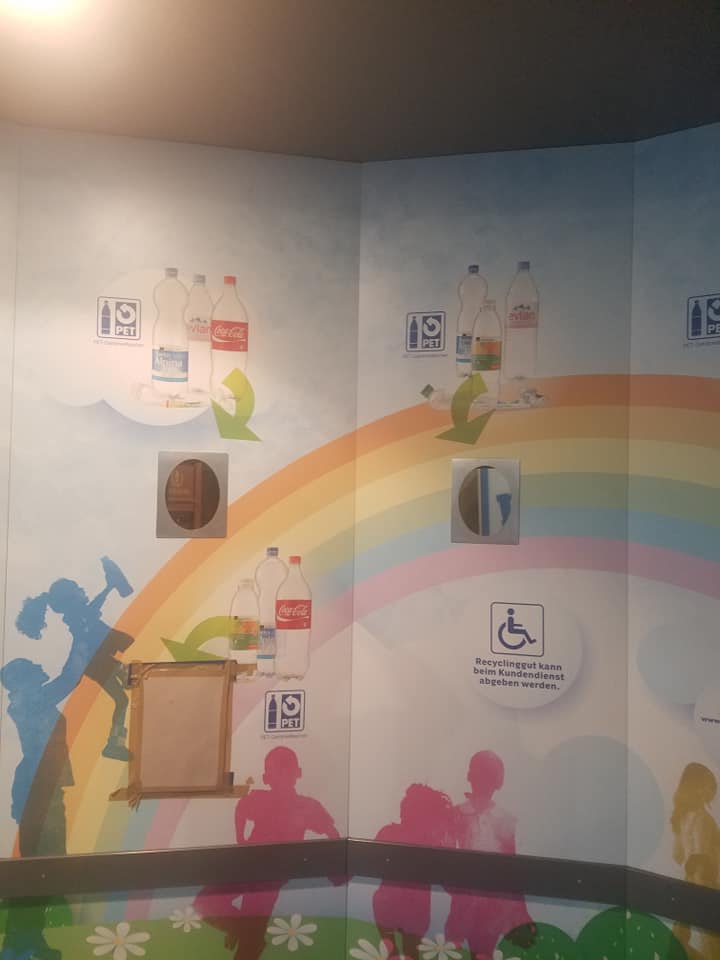
But only Flaschen. If you’ve got a plastic lid, takeaway container, broken toy, or piece of disposable tableware, it probably goes… in the regular Abfall. Many products are actually labeled with a cute little trash-bag-shaped icon to indicate that you have to throw them away.
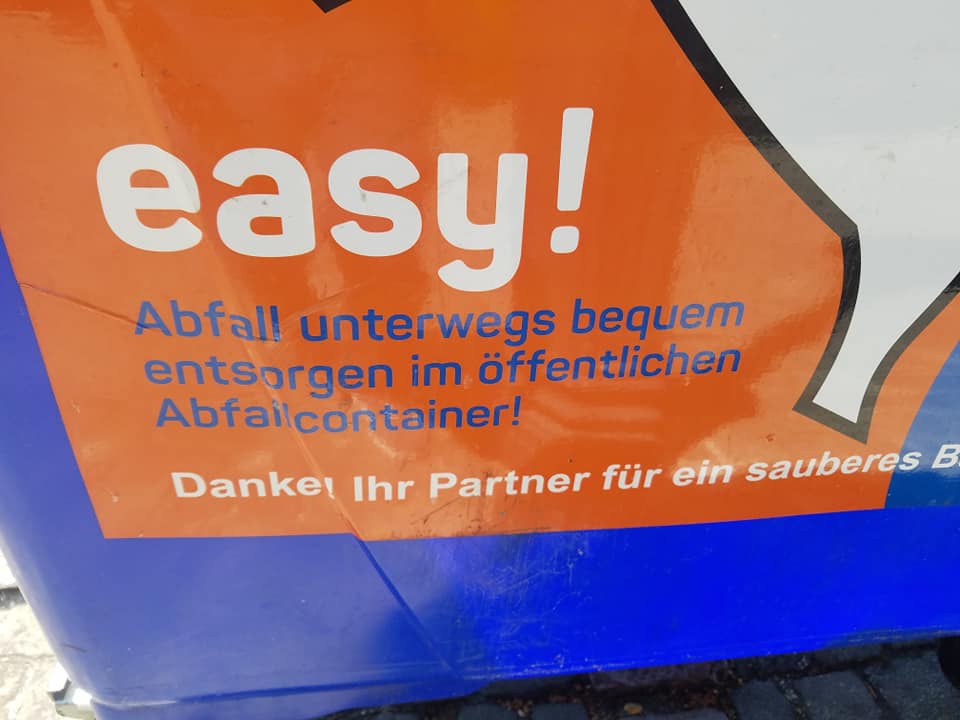
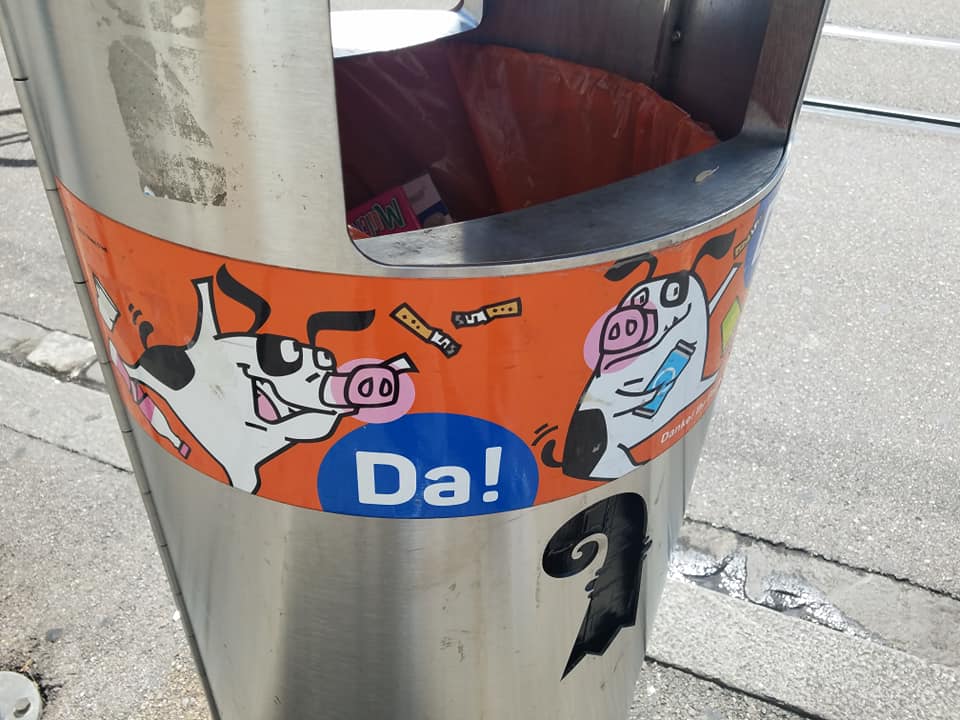
But there’s more! At the train station, the public trash and recycling bins are divided into Alu, PET, Papier, and Abfall sections… but no glass. And all over the city are public garbage bins lined with bright biohazard-orange bags that the cheerful cartoon pig implies are for everything, presumably to be sorted later. He’s cheering Da! Easy! (There! Easy!) for what look like cartoon cigarette butts, disposable aluminum bakeware, cans, bottles, and general waste. But he will totally mail a CHF200 ticket to your house if he catches you dumping your trash wholesale into a public bin.

 Not Somewhere I Ever Thought I Would Go
You are maintaining your high standard. Excellent writing.
LikeLike